Explain How Do We See Different Colours of an Object
Our vision adapts perfectly to the way in which we distinguish colors especially yellow. Sunlight is composed of the visible colours which are often categorised into.

I Can Describe Properties Of An Object Science Lessons Teaching Science Homeschool Science
Up to 24 cash back How do we see Colors.

. Dispersion of white light by a prism into a spectrum The spectrum. In summer yellow looks more greenish while in winter it looks more reddish or grayish. This mixture is known as white light.
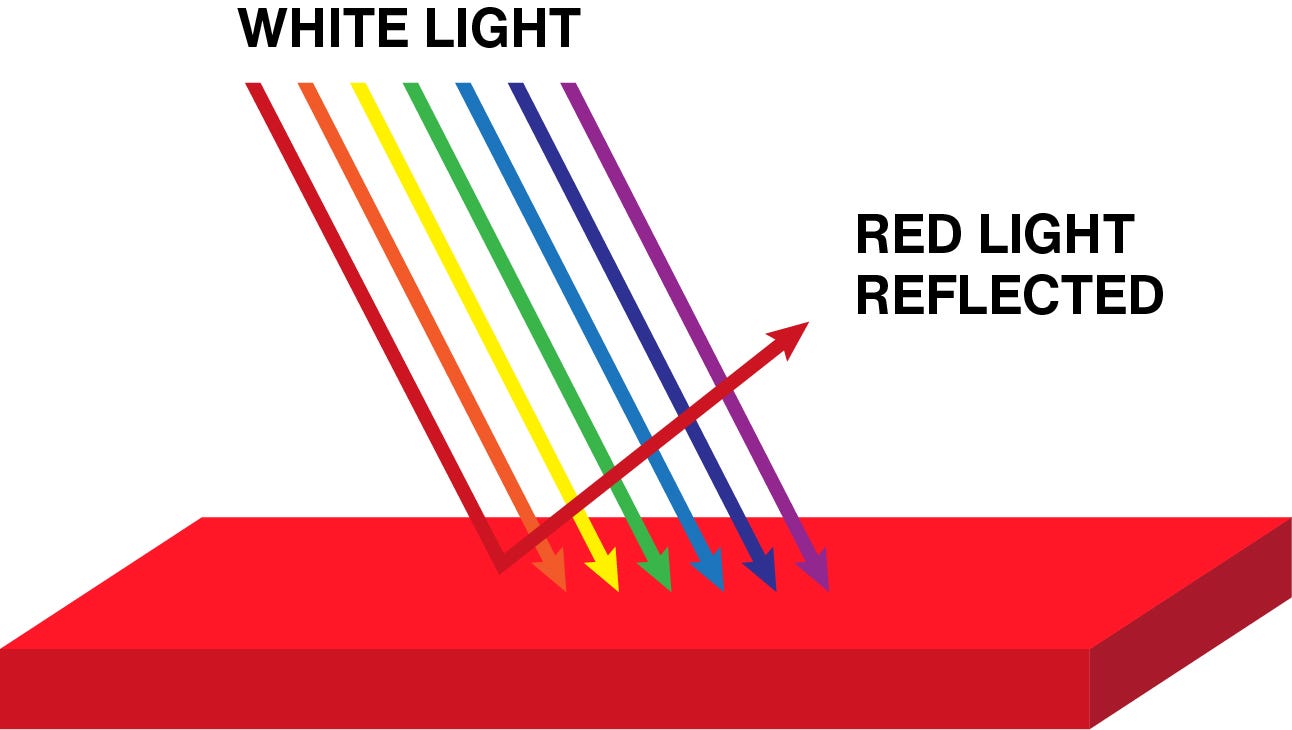
Objects appear coloured because of the way they reflect light. Some surfaces reflect all of this light while. The retina is covered with millions of light sensitive cells.
An object will look different in dim light versus bright light and some. We see color because light waves are reflected from objects to your eyes. I The colour of an object depends upon the wavelength of light it reflects.
We would like to use color to tell things apart but the only thing that you really know about the color of an object is the three-number code that it generates in your cones. For example a pure blue object illuminated with pure red light will appear black because it absorbs all the red light. A person often recognizes certain objects due to their color rather.
Summer Yellow looks different to us depending on the season according to scientists at. These objects do not shine with their own. Described by a color name Hue Visible spectrum The electromagnetic wavelengths visible to the human eye.
The absorption and reflection of light waves by various materials results in human perception of color as follows. Most materials absorb light. The colours we see are the wavelengths that are reflected or.
Ii This is because they do not possess some cone cells in their eye that respond to certain colours eg. Crayons or flowers because they reflect and absorb the rays of light that fall on them. When white light strikes a.
Explain how do we see different colours of an object. With flashlights filters le. The color of light coming from an object is what gives it color.
When a beam of white light falls on an object it absorbs certain wavelengths of light and reflects the other which is responsible for its colour. Objects appear different colours because they absorb some colours wavelengths and reflected or transmit other colours. The color statistics of objects are not random.
Roses are red and violets are blue but we only know that thanks to specialized cells in our eyes called cones. Light travels into the eye to the retina located on the back of the eye. Our emotions or even the time of year can change how our eyes and brains interpret what we see.
Join Rebecca Emerich Educational Outreach Manager as she uses everyday objects to explain absorption and reflection of light. We can see the colours of different objects eg. The cones in our eyes are active in light-rich environments and.
When you see objects you just receives light reflected or refracted from those objects which is perceived by your eye as color. This means that the light leaving the prism is spread out into its different colours a process called dispersion. Sunlight is a mixture of all colours of light which combine to form brilliant white light.
When light hits an object say a banana the object absorbs. An object can appear a different color under non-white illumination. Scientists explain that color in part is for object recognition.
Due to variations from person to person and differing environments the perception of color can vary wildly. Color is completely a phenomena of your eye. Red Orange Yellow Green Blue Indigo and Violet.
This area has millions of light receptors called cones and rods which react to light and tell our brains what colors we see. Get the answers you need now. Red-green colour blind person does not possess red and.

How Do We See Color Pantone
How Do We See Color Pantone

Describing Objects Using Color Sight Words Describing Words Sight Words Words
How Do We See Color Pantone


Comments
Post a Comment